Let’s start with the top 5 bouldering areas in Germany (Bouldergebiete Deutschland)
Anyone who claims that Germany isn’t a great place to boulder outdoors is completely wrong. Germany’s bouldering areas may not be among the largest on the planet, but they’re certainly not inferior to other regions in terms of quality and diversity. Rock types of all kinds await you. From granite in the northern Odenwald, to beautiful sandstone in the Palatinate, which easily creates a „bleau“ feeling, to rough volcanic rock in the Eifel, there’s something for everyone in Germany. Here’s our selection of the 5 best bouldering areas in Germany.

Odenwald
Bouldering areas in Germany (Bouldergebiete Deutschland): The bouldering area of the northern Odenwald is located primarily in southern Hesse, near Darmstadt. It is characterized by its characteristic granite rock, known for its grip. The individual blocks feature rounded edges (slopers). However, you’ll also find the occasional razor-sharp ledge and a few slabs.
A major advantage of the granite rock is that it dries quickly after rain. One thing you have to get used to, however, is the sharp rock structure. It’s best not to slip here. All in all, the Odenwald is rightly considered one of the best bouldering areas in Germany.
Tip: The „Pyramid“ in the Felsenmeer near Beedenkirchen is truly a dream of a slab. A block about 4–5 meters high, inclined at an angle of about 60°, it’s perfect for honing your foot technique.
Very important to note: Please always take your trash with you. The Felsenmeer is heavily frequented by tourism alone, and you’ll find some packaging on the ground here and there.
Palatinate

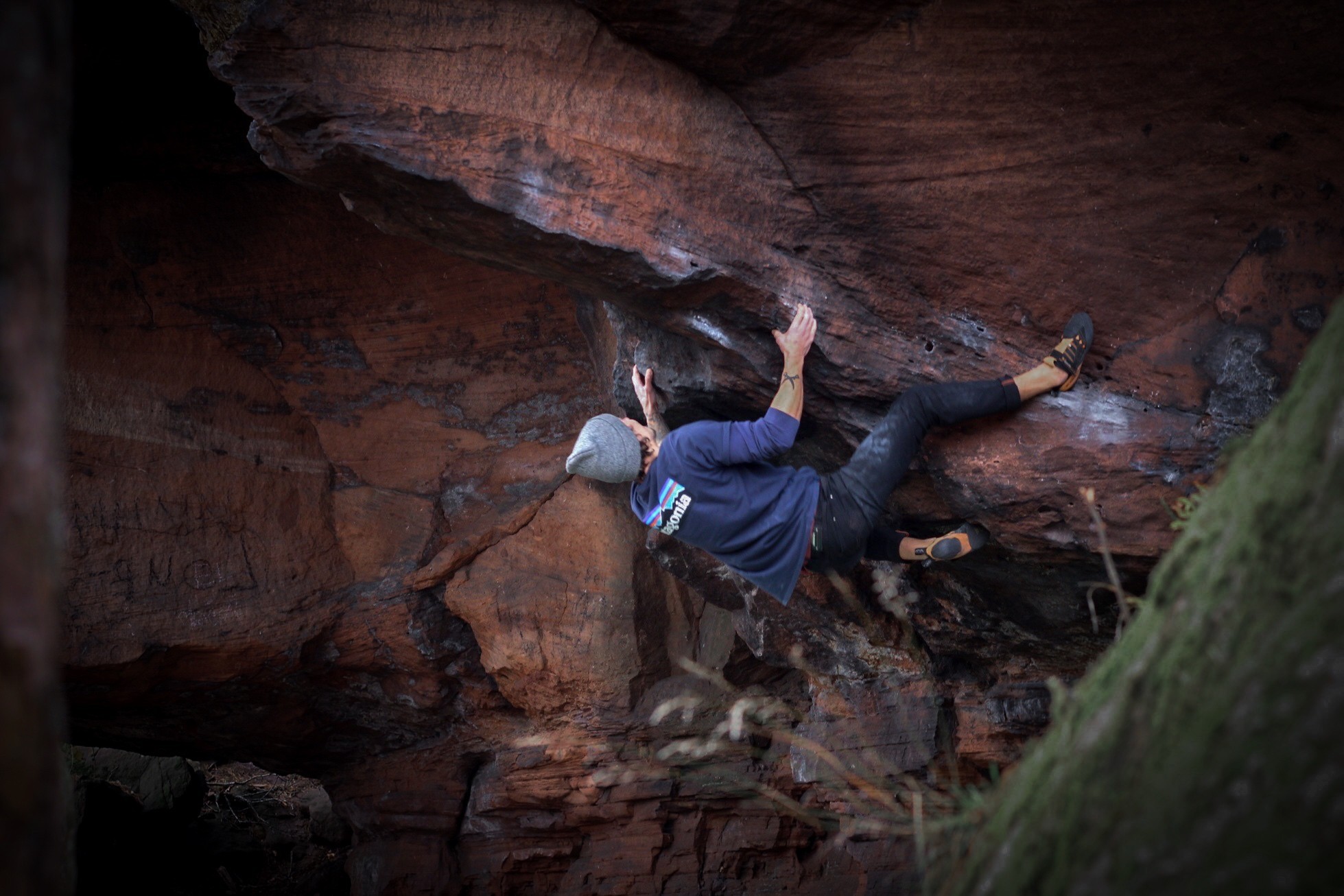
Bouldering areas in Germany (Bouldergebiete Deutschland): Germany’s bouldering areas offer a wide variety of different rock types. The sandstone combined with the pine trees in the Palatinate region often leaves some with a „Bleau feeling.“
The bouldering area is divided into the Vorderpfalz and Central Southern Palatinate regions. They comprise more than 1,000 bouldering challenges. In the Vorderpfalz, bouldering is mostly done in the Haardt and Kalmit areas. Both areas have their advantages; the rock quality is simply excellent in both. There’s no excuse for a lack of friction here. From bouldering styles, you’ll find everything from extremely flat Bleau slabs to mega overhangs with insane compression moves.
Tip: be sure to stop by the Energy Center block in Haardt; the sight of the overhanging 6 m block alone is definitely worth the trip.
Very important to note: Chalking is strictly prohibited in the Haardt 1 area! Unfortunately, many pieces of isolated blocks have broken off in recent times. Sandstone is extremely fragile when wet and should be avoided at all costs. Again, please do not attempt to dry out the rock with chalk, as this will only damage it further. Please respect this; you will be doing yourself and future generations a favor by maintaining the rock’s quality.
Avalonia
Bouldering areas in Germany (Bouldergebiete Deutschland): Small but mighty! That probably describes the bouldering area in the Ruhr Valley near Hagen quite well. It offers approximately 150 boulders on the finest Ruhr sandstone, ranging in difficulty from 3 to 8a+ on the FB scale. A name that is often heard in connection with the area is Daniel Pohl. He developed the area and exposed the lines. He also infused his artistic soul into the area. If you’d like to learn more, there’s a highly recommended Patagonia documentary called „Stone Locals,“ which explores the topic of Avalonia and Daniel Pohl in more detail.
Tip: Avalonia Topos are available in the area on Saturdays and Sundays between 8:30 and 17:30. These are uniquely hand-designed pieces.
Eifel
Bouldering areas in Germany (Bouldergebiete Deutschland): In the Eastern Eifel, also known colloquially as the Volcanic Eifel, there is another bouldering area in Germany.
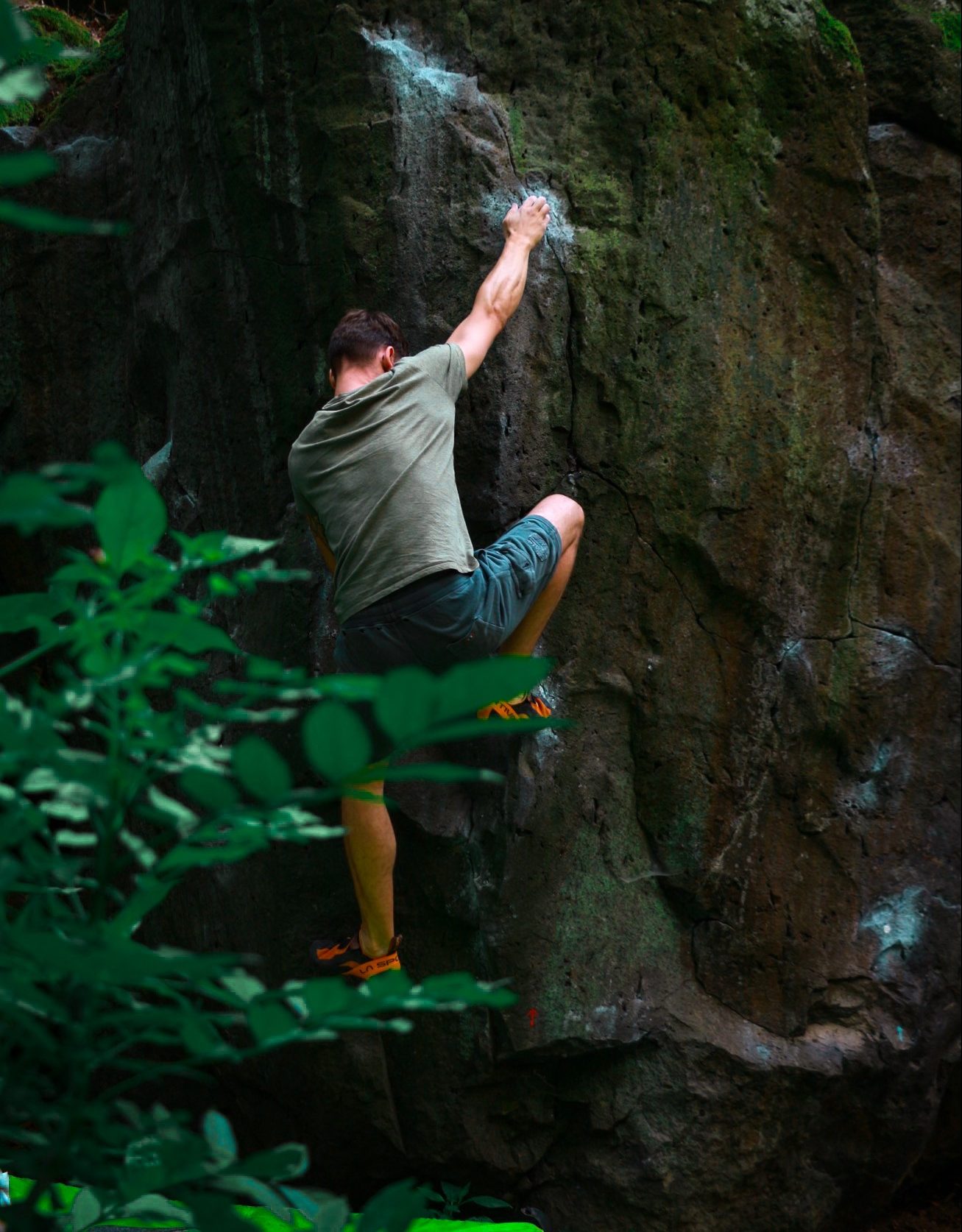
It lies between the two towns of Glees and Burgbrohl. As the name Volcanic Eifel suggests, you’ll find boulders made of volcanic rock, specifically basanite.
The Glees bouldering area is divided into nine different sectors and comprises approximately 300 lines, most of which are located on columns. This also means that Glees also has many refrigerator boulders. Those who want to boulder in Glees can be enchanted by a mystical forest. This impression is best experienced in the „Romani ite Domum“ sector. Parts of the forest floor there are covered in ivy, simply beautiful.
Tip: directly in the first sector is the Bleausard block with the boulder „Bleausard“, one of the most beautiful lines in grade 6 of the FB scale.
Very important to note: Please follow local guidelines and only use permitted trails. We all want to continue bouldering in Glees.
Allgäu
Bouldering areas in Germany (Bouldergebiete Deutschland): Last but not least on the list of the best areas is the Allgäu, the southernmost of the five. It offers a selection of almost 2,000 boulders spread across more than 20 areas. In terms of rock types, there are almost no limits. You can choose from limestone, sandstone, marl, dolomite, and, in most cases, conglomerate. The difficulty levels here range from 1 to 8b+ on the FB scale. Most of the routes are overhanging.
Very important to note: Please also pay attention to local regulations regarding nature conservation or similar. Bouldering is becoming increasingly popular and has a bad reputation due to the misconduct of individuals in nature. This must change; we all have a responsibility here.
Bouldering areas Germany Conclusion:
All in all, we can consider ourselves extremely fortunate to have such a wide variety of opportunities to pursue our passion for nature. Bouldering areas in Germany: Which is ultimately the best is difficult to say and depends primarily on the individual. One thing is certain: the bouldering areas mentioned all have their own appeal, and a visit to each one will be an equally unique experience. Most importantly, the bouldering community must work together and always behave responsibly toward nature, so that we and future boulderers can continue to visit these beautiful places in the distant future.